Democratic Party They re Going to List Again
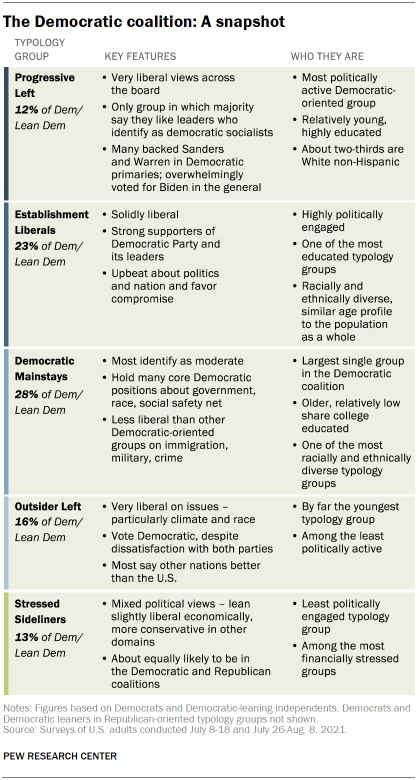
As in previous political typologies, the groups that form the Democratic coalition are largely united in support for a robust role of regime and a potent economical and social safety net, besides as in their skepticism about corporate ability. However, there are notable differences across the coalition around views of U.S. military might and – to some extent – views related to criminal justice and immigration.
And in several key issue areas – including environmental policy, gun policy, abortion, racial equality and other topics – differences beyond the coalition are less well-nigh the issue itself than in the intensity of support for liberal positions and policies.
This is also the instance when it comes to some aspects of economic policy. Despite sharing the behavior that economic inequality is a problem in the country, that the economic system favors powerful interests and that government should play a role in addressing inequities, the Autonomous-oriented groups differ both in their views about the magnitude of the bug and in their level of support for proposed solutions.
In several other domains, divides seen in past typologies across the Democratic-oriented groups – particularly over social issues – are now areas where there is mostly more agreement among Democrats than in the GOP coalition.
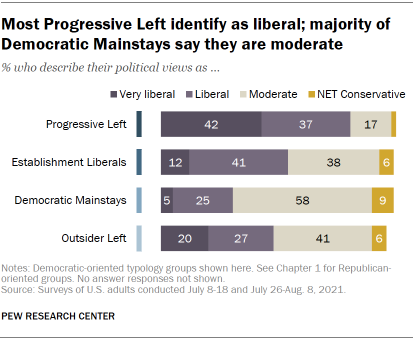
In part because some problems that used to dissever the Democratic Party – similar same-sex activity marriage, ballgame and marijuana legalization – are no longer major fault lines, cleavages on the left flank of the political party are now more than evident. And, for the first time, this year'due south political typology identifies not just a single solid liberal group, but distinctions across several liberal groups.
The most liberal grouping – nearly 80% telephone call themselves liberal, including 42% who describe themselves as "very liberal" – Progressive Left brand up a relatively pocket-size share of the political party, 12% of Democrats and Democratic-leaning independents. Withal, this group is the about politically engaged segment of the coalition, extremely liberal in every policy domain and, notably, 68% White non-Hispanic. In contrast, the three other Democratic-oriented groups are no more than nigh half White non-Hispanic.
Institution Liberals, who make upwards a significantly larger share of the party (23%) than Progressive Left, too vote at high rates and are very politically attentive.
But while Establishment Liberals have liberal opinions on nearly all bug, they tend to back up more measured policy approaches and are more likely to back political compromise than Progressive Left and, to some extent, Outsider Left.
For instance, while all Autonomous groups say by wide margins that more needs to be washed to ensure equal rights for all Americans, regardless of their racial or ethnic backgrounds, Establishment Liberals are somewhat more than probable than other groups to say needed changes can exist made within existing laws and institutions. A majority likewise say the party should exist at to the lowest degree somewhat accepting of members who sometimes agree with the GOP on problems.
Democratic Mainstays – the largest single group in the Democratic coalition this year (constituting 28% of Democrats and Autonomous leaners) – are considerably more than likely than other groups to phone call themselves politically moderate. Still, they concord near every bit liberal positions as other Democratic-oriented groups on economical issues, while they diverge from others in the coalition somewhat on clearing problems. (For instance, they are much less likely to support increasing legal immigration and more probable to identify illegal immigration as a problem in the country.) They besides are more invested in U.S. military machine power than other Democratic-oriented groups. Black Democrats are especially concentrated in this group: 40% of Black Democrats are Democratic Mainstays. Mainstays are too older and less likely to be college educated than other segments of the coalition.
Outsider Left – 16% of Democrats and Autonomous leaners – are immature, progressive and non particularly at ease within the Democratic Party. Though they are not quite as liberal across the board as Progressive Left and express some skepticism about government performance, their liberalism is particularly evident when information technology comes to race, immigration and ecology issues.
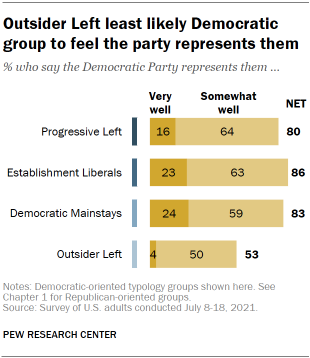
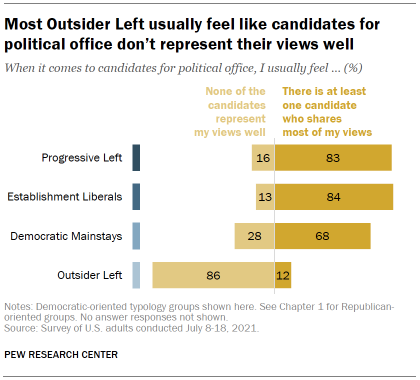
While Outsider Left are more probable to identify every bit political independents than as partisans – and nearly nine-in x (86%) say that they usually don't feel similar there are political candidates that represent their views well – their dissatisfaction with the party largely comes from a liberal, not moderate, perspective.
Outsider Left are not as reliable voters as other Democratic-oriented groups, but when they exercise vote and are faced with a choice between GOP and Democratic candidates, they overwhelmingly bandage their votes for Democrats.
Stressed Sideliners, despite not having a articulate partisan tilt, make up small but significant shares of both the Democratic and Republican coalitions (xiii% of Democrats and Democratic leaners, xv% of Republicans and Republican leaners). This grouping is financially stressed and relatively unengaged with politics. They mostly have attitudes that place them almost the eye of overall public opinion, tilting more liberal than conservative on economic issues, while tilting more conservative on some social issues. And while they vote at significantly lower rates than other typology groups, 45% of them cast ballots in 2022 – roughly half of them voting for Joe Biden.
An additional 8% of Democrats and Democratic leaners belong to a GOP-oriented typology group (the majority of whom are role of Clashing Right). These are individuals who lean Democratic, but whose values and attitudes are more aligned with a group whose other members tend to be affiliated with the GOP. (Similarly, 6% of Republicans and Republican leaners belong to Democratic-oriented typology groups.)
Areas of full general agreement within the Democratic coalition
Three-quarters or more of those in all four core Democratic-oriented typology groups say regime should do more to solve issues. There is fifty-fifty more than widespread understanding inside the coalition that the economy unfairly favors powerful interests and that tax rates on big businesses and corporations – and on households with incomes over $400,000 – should exist raised, as should the federal minimum wage.
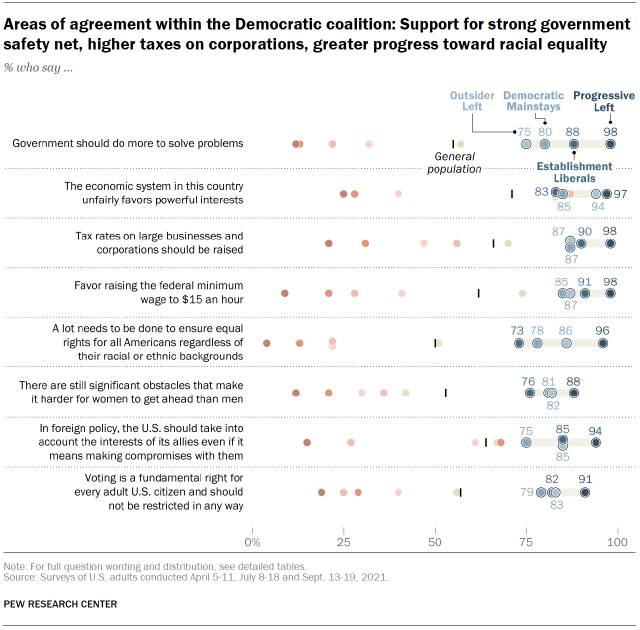
On questions of racial disinterestedness in society, Autonomous-oriented groups also by and large share a sense that more needs to be done in the state to achieve racial equality, that White people benefit from advantages in guild that Black people do non, and that Black, Asian and Hispanic people confront at least some discrimination in society.
About three-quarters or more in all four groups as well say that women continue to face meaning obstacles in society that brand it harder for them to get ahead than men.
The coalition is largely united on key issues related to voting rights and access. Broad majorities say voting is a key right that cannot exist restricted; about three-quarters or more favor several reforms similar making Election Twenty-four hours a national holiday, automatic voter registration, assuasive convicted felons to vote afterwards serving their sentences and expanding early voting. Note: For full question wording and distribution on each question, see detailed tables.
Divides inside the Democratic coalition
Despite largely agreeing on primal economic attitudes, at that place are areas where aspects of the Democratic coalition diverge. Progressive Left stand up out as the but typology group in which a majority say that "success in life is pretty much determined by forces beyond our control" (rather than that "everyone has it in their ain ability to succeed"). And while 73% of Progressive Left say the fact that there are billionaires in this country is bad for the state, equally do 55% of Outsider Left, almost Democratic Mainstays and Establishment Liberals do not share this view.
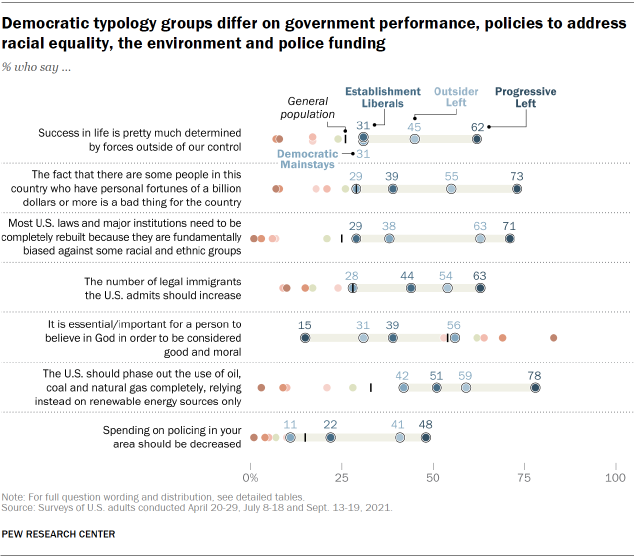
Although majorities across all Democratic-oriented groups say more needs to be done to address racial inequities in social club, the groups differ on how to attain needed change. Articulate majorities of Progressive Left (71%) and Outsider Left (63%) say modify will require completely rebuilding well-nigh U.S. laws and institutions because they are fundamentally biased against some racial and ethnic groups, while far smaller shares of Autonomous Mainstays (38%) and Establishment Liberals (29%) say this.
Democratic-oriented groups likewise differ over the extent to which they see immigration equally a good, with Democratic Mainstays, in particular, offering somewhat more conservative views. For example, while 63% of Progressive Left and 54% of Outsider Left say the U.S. should admit more than legal immigrants, that drops to 44% of Institution Liberals and 28% of Democratic Mainstays (most say the number of legal immigrants should stay near the aforementioned).
Democratic-oriented groups are largely united in saying that climate change is a large trouble for the country, that stricter environmental laws are worth the cost and that the priority for energy investment should be on developing culling sources – like current of air, solar and hydrogen. Simply differences emerge when it comes to the intensity of these views. Most viii-in-ten Progressive Left (78%) say that the U.S. should phase out the utilise of oil, coal and natural gas entirely, a position taken by a narrower majority of Outsider Left (59%), forth with nigh half of Establishment Liberals (51%). Past contrast, a smaller share (42%) of Democratic Mainstays hold this view, while a narrow majority (55%) say instead that the country should utilize a mix of energy sources, including fossil fuels.
Well-nigh half of Progressive Left (48%) say police funding in their area should be decreased, equally do 41% of Outsider Left. But both Democratic Mainstays and Establishment Liberals reject this thought. In fact, both groups are more probable to say that police funding in their areas should be increased than to say it should be decreased: 47% of Autonomous Mainstays say police funding should exist increased, while simply xi% say it should be decreased. Among Institution Liberals, 31% say it should be increased, 22% say information technology should exist decreased and 47% say it should stay the same.
The Autonomous-oriented groups: Voting and views of the presidents
In the 2022 election, Joe Biden garnered the vast majority of votes bandage by those in all four of the Democratic-oriented groups. Among 2022 voters, 92% of Democratic Mainstays and 94% of Outsider Left voted for Biden – as did nearly all Institution Liberals and Progressive Left (98% each). But some groups were more likely to turn out than others. Fully 86% of Progressive Left and 78% of Institution Liberals have a record of having voted in 2020, while that drops to 68% among Autonomous Mainstays and to 57% among Outsider Left. And although a bulk of Stressed Sideliners did not vote, those who did were virtually evenly split betwixt Biden and Donald Trump in their votes (48% vs. 49%, respectively).
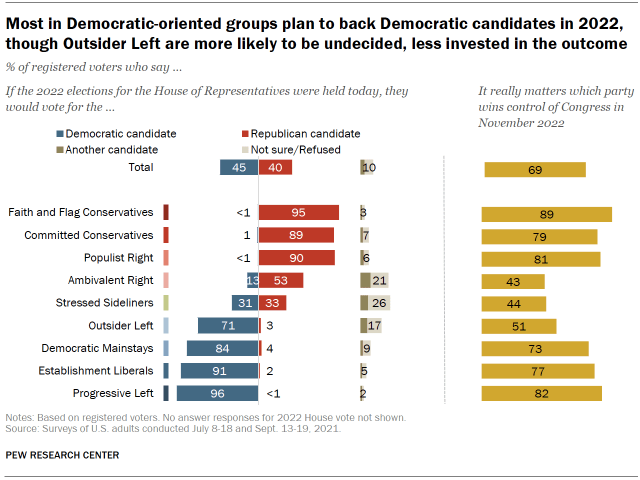
Like patterns are axiomatic in vote intention for the 2022 midterm elections. While overwhelming majorities of registered voters in all four Democratic-oriented groups say they would vote for a Autonomous House candidate over a Republican candidate, Outsider Left are far less likely than others to say that command of Congress "actually matters" – and they are somewhat more likely than other groups to say, when faced with the option of a Democrat or a Republican for their Firm seat, they'd opt for "another candidate" (8%) or say they are not sure (17%).
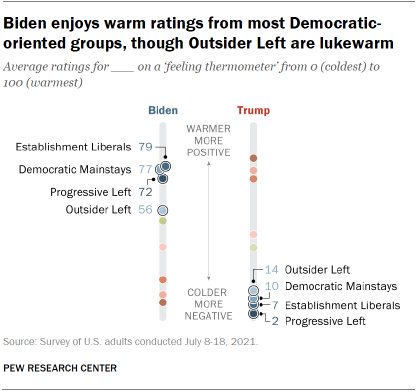
While Biden won the votes of overwhelming majorities of those in all Democratic-oriented groups who voted in 2020, some groups feel more positively than others almost the president. Asked to rate Biden on a "feeling thermometer" where 0 is the coldest rating and 100 is the warmest, Institution Liberals offer an average rating of 79, or very warm, while Democratic Mainstays' average rating of Biden is a similarly very warm 77. Progressive Left also rate the president warmly, though somewhat less and then (boilerplate 72), while Biden averages a lukewarm 56 degree rating amid Outsider Left.
Even so ratings of Biden's 2022 full general ballot opponent amid these groups are more uniform. Trump'due south rating tops out at a very cold average 14 degrees among Outsider Left and is a frigid 2 degrees among Progressive Left.
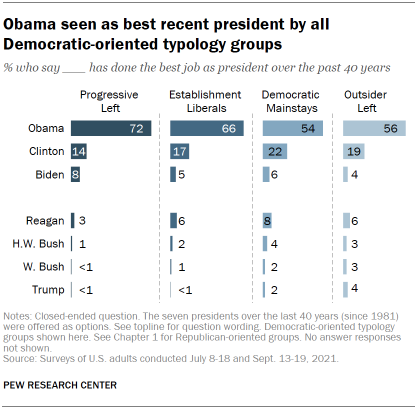
Majorities in all Democratic-oriented typology groups point to Barack Obama as the best president of the concluding forty years. Progressive Left (72%) and Institution Liberals (66%) are particularly likely to say this. While a 54% bulk of Democratic Mainstays name Obama, 22% of this grouping proper noun Pecker Clinton, a college share saying this than among Progressive Left (14%) and Establishment Liberals (17%).
The 2022 Democratic chief through the lens of the typology groups
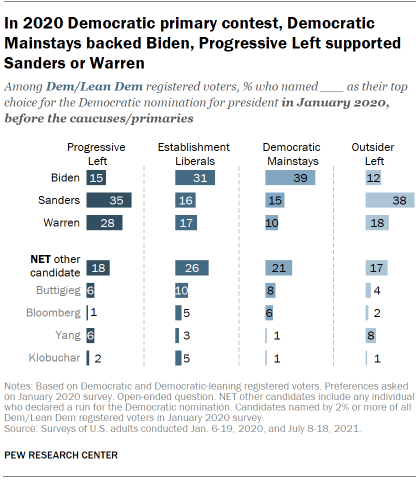
Looking back to the 2022 Democratic presidential master contest, the Autonomous-oriented typology groups had distinctly dissimilar preferences heading into the commencement caucuses and primaries. In Jan 2020, when at that place were still about a dozen Democratic candidates in the running, 39% of Democratic Mainstays named Biden as their first option for the nomination, more than twice as many as named whatever other unmarried candidate. Biden as well held an edge among Establishment Liberals, though about a quarter of this group (26%) named candidates with less overall back up (then-Mayor Pete Buttigieg, Sen. Amy Klobuchar, Michael Bloomberg and others).
Past comparison, Sen. Bernie Sanders had the back up of 35% of Progressive Left, with this group nearly equally likely to proper noun Sen. Elizabeth Warren (28%) as their get-go option – and a far smaller share (15%) naming Biden. And while Outsider Left were like to their Progressive Left co-partisans in their support for Sanders (38% named him), they were less likely to back Warren (18%).
Who should be allowed in the Democratic Party tent?
Although a majority of Democrats and Democratic leaners say the Democratic Political party should be generally accepting of elected officials who are openly disquisitional of Biden, that sentiment differs across Democrats within typology groups: While just 25% of Progressive Left and 30% of Outsider Left say the party should non be accepting of those who are critical of the president, that rises to 42% amid Democrats who are Establishment Liberals and 55% of those who are Democratic Mainstays.
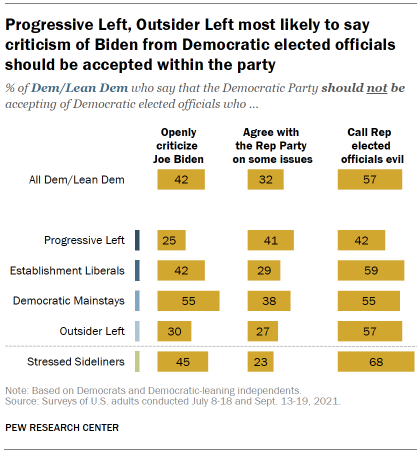
Progressive Left, past contrast, are more probable to say the party should not be accepting of members who hold with the Republican Political party on some bug (41% say this, as practice 38% of Democratic Mainstays, while merely 29% of Establishment Liberals and 27% of Outsider Left say the aforementioned).
And while majorities of Democrats who are Establishment Liberals (59%), Autonomous Mainstays (55%) and Outsider Left (57%) say the Autonomous Party should non be accepting of elected officials who call GOP elected officials "evil," that drops to 42% among Progressive Left.
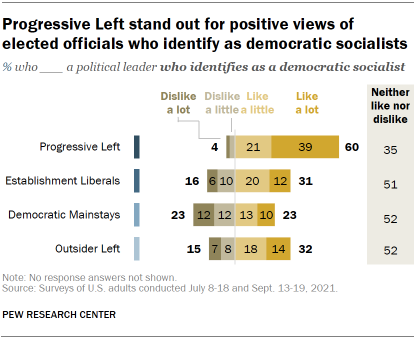
Today, Progressive Left are the only typology grouping in which a majority say they like political leaders who identify as democratic socialists – 60% say this, while only 4% say they do not. Both Establishment Liberals and Outsider Left are more than likely to say they like this about a political candidate than to say they dislike it; still, almost half of those in these groups say they neither similar nor dislike candidates who use this self-description.
Autonomous Mainstays are the least likely to say this label appeals to them – merely 23% say it does, the same share who say they dislike the label. Most half (52%) say they neither similar nor dislike information technology.
Race and ethnicity, historic period and the Democratic coalition
Democratic Mainstays make upward 28% of the Democratic coalition – the largest single group. But they are an even larger share of Black Democrats: Four-in-ten Black Democrats are Autonomous Mainstays. Past comparing, the share of Black Democrats who are Establishment Liberals is nearly identical to the overall share of Democrats who fall into this group. And simply 12% of Blackness Democrats are Outsider Left, while just 6% are Progressive Left, in both cases substantially smaller shares than in the overall Democratic population.
Hispanic Democrats too are somewhat less likely than Democrats as a whole to be Progressive Left (simply 7% of Hispanic Democrats are Progressive Left). However, nineteen% are Outsider Left. Hispanic Democrats are somewhat more likely than Democrats in other racial and ethnic groups to fall into GOP-oriented political typology groups.
Roughly a third of Asian American Democrats (32%) are Establishment Liberals – a larger share of Asian Democrats belong to this group than among White, Blackness and Hispanic Democrats. Asian American Democrats are as well more likely than White and Blackness Democrats to be Outsider Left – roughly a quarter fit into this group (24%). And Asian American Democrats are far less likely than Democrats as a whole to be Democratic Mainstays – but 19% are in this group.
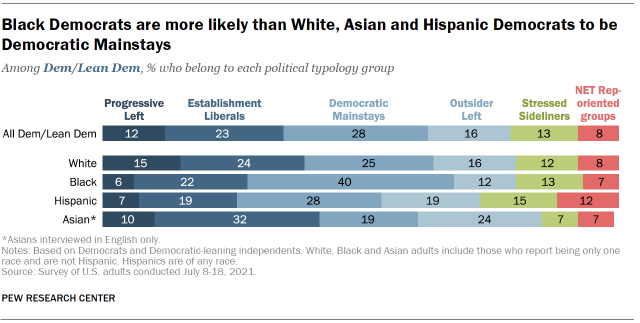
A quarter of White Democrats are Democratic Mainstays, while a similar share (24%) are Establishment Liberals, 16% are Outsider Left and xv% are Progressive Left – a larger share than amidst Black or Hispanic Democrats.
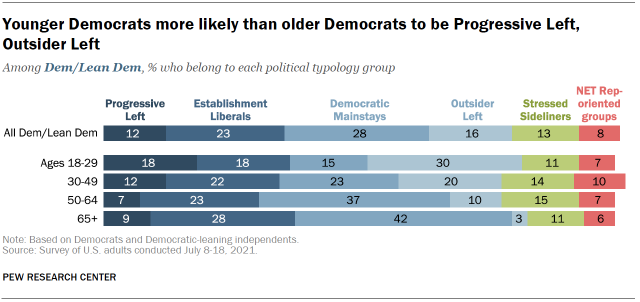
Older Democrats are far more than likely than younger Democrats to exist Democratic Mainstays: 42% of those ages 65 and older and 37% of those 50 to 64 belong to this group. Past comparison, just 15% of Democrats nether age 30 and 23% of those thirty to 49 are Mainstays.
In dissimilarity, the largest single group among Democrats ages 18 to 29 is Outsider Left, with 3-in-ten falling into this grouping. The youngest Democrats are also more likely than older Democrats to be Progressive Left.
schofieldwititival.blogspot.com
Source: https://www.pewresearch.org/politics/2021/11/09/the-democratic-coalition/

Enregistrer un commentaire for "Democratic Party They re Going to List Again"